A Diagram of a Plant Cell
Although plant cells differ greatly they all have similar eukaryotic organisation. It can be seen in this diagram of a plant cell that the cells are made up of many different parts; these are known as organelles. These are described in more detail below.
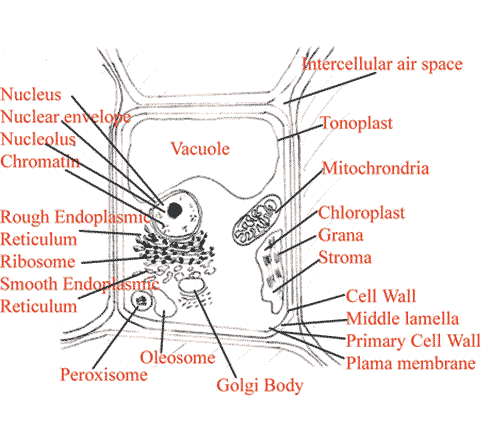
Parts shown in the Plant cell diagram
Below is a list of the main parts shown in the plant cell diagram and the roles that they play in the cell.
Nucleus - contains the genetic information of the cell.
Nuclear envelope - double membrane surrounding the nucleus.
Perinuclear space - space between the two membranes of the nuclear envelope.
Nucleolus - site of ribosome synthesis - densely granular.
Chromatin - DNA-Protein Complex.
Ribosomes - site of protein synthesis.
Rough Endoplasmic Reticulum - covered in ribisomes - lamellar.
Smooth Endoplasmic Reticulum - tubuler.
Golgi Body - synthesis and secretion of polysaccharides.
Chloroplast - Site of Photosynthesis.
Granum (Grana) - stacked thyalkoid membranes.
Stroma - fluid matrix surrounding the thylakoids.
Thylakoid - Membrane found in the chloroplast.
Intercellular air space - gap between cells.
Cell Wall - Rigid structure surrounding plant cells, not present in animal cells.
Middle lamella- protein rich cement between adjacent plant cell walls.
Primary Cell Wall - earliest created cell walls - usually thin - found in young growing cells.
Secondary Cell Wall - Formed in older cells as part of the differentiation process.
Plasma Membrane - Outer boundary of the cell.
sMitochrondrian - Energy producing organelle - respiration.
Peroxisome- Removes hydrogens from substrates - present in photosynthetic cells - has a crystalline core.
Oleosome - Oil lipid storage (seeds).
Vacuole -
Water filled part of the cell that may represent up to 90% of the total plant cell - also contains ions, sugars, secondary metabolites and enzymes.
Tonoplast - Membrane surrounding the Vacuole.
An Explanation of the Key Cell Differences Between Plants and Animals
As plants are eukaryotic organisms, their cells have many similarities with other eukaryotic cells such as those found in animals. In spite of these similarities there are lots of ways in which animal and plant cells differ. Amongst the ways in which plant cells ablude from animal cells is the fact that they contain a fluid filled vacuole and have a hard outer wall; this is made of cellulose.
In addition to the cell walls and vacuoles another key difference between plant and animal cells is that they contain the chloroplast organelle; see plant cell diagram above. The chloroplast is the area of the plant that is involved in the conversion of light energy into starch through a process that is known as photosynthesis. Another plastid that is only found in plants is the amyloplast, this acts as a starch storage vessel.
The major differences between plant and animal cells are the presence of the cell wall, vacoules and chloroplast. As both animals and plants are eukaryotic organisms they also share many features within their cells, some of the organelles that they share include the nucleus, which contains the chromosomes and DNA; the ATP producing mitochondria; the protein processing golgi bodies and endoplasmic reticulum, and the 'liquid soup' cytoplasm.
It is these differences in plant cell make up that allows the plant to be such a successful sessile organism, for example it is the rigidity provided by the cellulose containing cell walls that give many plants the strength and support to grow to vast heights. The turgidity of a plants cell is provided by the liquid filled vessels that are the vacuoles. The chloroplast contains pigments known as chlorophyll, these appear to be green in colour; this is because they do not absorb green light, but that of red, far-red (Phytochromes) and blue. The eye than sees the reflected green light, it is this phenomenon that is responsible for the green colour of plant leaves. The process of photosynthesis takes place in the chloroplasts and allows the conversion of energy gathered from sunlight into starch through the use of carbon dioxide.
A plant contains specialised phloem cells, these enable the transport of signalling plant hormones and essential nutrients throughout the plant. In addition to the phloem, a plant has a transportation system known as the xylem; this system is formed from the lignification of cells to create xylem tissue, and is largely responsible for the transportation of water throughout a plant.